(jeg svarede okey-dokey til noget korrektur-relateret og bidragyderen svarede, at hun netop havde besluttet at anvende udtrykket oftere)
Okey-dokey! The story of the birth of OK’s playful grandchild
By the early twentieth century,
OK was no longer a joke. The letters O and K did not prompt memories of the misspelled
oll korrect,
nor did they stimulate alternative explanations. In the nineteenth
century, OK was recognized as a humorous abbreviation, but in the
twentieth, it was understood merely as an
arbitrary combination of letters of the alphabet.
The very look of OK underwent a change. In the nineteenth century, OK
almost always appeared with periods, identifying it as an abbreviation.
In the twentieth, however, the periods increasingly were absent. And in
the twentieth century, more and more it was spelled okay, completely
distancing it from any abbreviation and transforming it into an ordinary
word.
The meaning of OK was simplified in the twentieth century too. Almost
from the date of its birth, in the nineteenth century the abbreviation
OK was subject to reinterpretation, beginning with
Old Kinderhook
and continuing with numerous humorous inventions, as well as the names
of clubs. As the twentieth century got under way, those alternatives
faded, leaving OK for the most part with the plain,
sober
definition “all right.” Gaining familiarity rather than passion, OK
also gained the abbreviation oke in the 1920s, and kay or just plain k,
both in writing (nowadays including text messages and e-mail) and
speaking.
Along with the draining of humor from OK came the draining of
enthusiasm, or indeed of any emotion. In 1840 the OK Clubs could inspire
voters to support Old Kinderhook for reelection. The clubs formed later
in the nineteenth century, from the Harvard OK on down, likewise kept
OK spirited. In occasional literary use, OK often colorfully evoked the
voice of a decidedly backwoods character. But by the early twentieth
century, OK had become value-neutral. It remained
affirmative, but it imparted no
attributes, admirable or otherwise, as it remains today.
When a friend nowadays asks “What do you think of my garden?” to
answer “OK” is likely to make the respondent the target of a flowerpot.
You’d better use a
value
word like “wonderful” or “perfect”. Even “terrible” shows more
emotional involvement than OK. So OK no longer was a joke or a
showstopper. In the nineteenth century, OK stood out, but in the
twentieth, OK was just OK.
To make OK funny in the twentieth century, or to give it emphasis, it needed a
twist.
And the Roaring Twenties came up with it—several twists, in fact.
Beginning in the 1920s we find such twists as okey-dokey and oke-doke,
leading up to the okely-dokely now used by cartoon character Ned
Flanders on the television show
The Simpsons.
The rise of okey-dokey and its relatives took away the pressure on OK
to be funny. Once okey-dokey made its appearance, any vestige of humor
associated with OK fled to its
polysyllabic progeny,
leaving OK free of all remaining traces of playfulness. We are inclined
to smile when we hear okey-dokey; we hear plain OK with a straight
face. The expression born as a
blatant joke a century earlier had now become a sober workhorse, ready to undertake ventures in
pragmatics and
psychology in the postwar years.
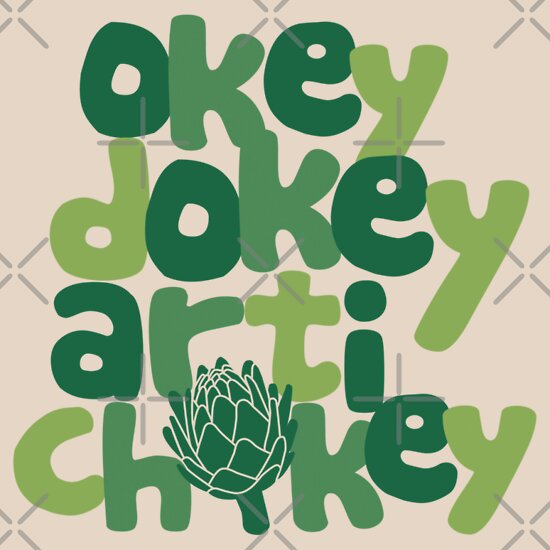
The playfulness of okey-dokey is evident when it turns up as the name for a recipe in
Fondue by Lenny Rice and Brigid Callinan, published in 2007. The artichoke
fondue
“Okey-dokey Artichokey” is to be paired with Austrian grüner veltliner,
which “has a crisp, peppery quality that makes it one of the only
reliable artichoke-friendly wines we know.”
Perhaps the name of the recipe was inspired by a children’s book published four years earlier,
Okie-dokie, Artichokie! by Grace Lin. That’s the story of a new downstairs neighbor named Artichoke who bangs mysteriously on his ceiling, the
protagonist’s
floor. “Hey, if I get too loud or something, you can just bang on the
ceiling and let me know,” says the protagonist, who happens to be a
monkey. The downstairs neighbor is a giraffe, hence the
inadvertent banging.
By now, okey-dokey (and variants like okely-dokely) has long lost its
freshness—hence its suitability for a not-so-cool character like Ned
Flanders. For some, it’s an annoyance. Slang expert Tom Dalzell, in
The Concise New Partridge Dictionary of Slang and Unconventional English
(2007), acknowledges that okey-dokey is “used for communicating
agreement,” but he can’t resist grumbling that it is “an old-fashioned,
affected, still popular
perversion of OK.”
Edited extract from OK: The Improbable Story of America’s Greatest Word by Allan Metcalf. Published in Paperback by Oxford University Press in 2012.