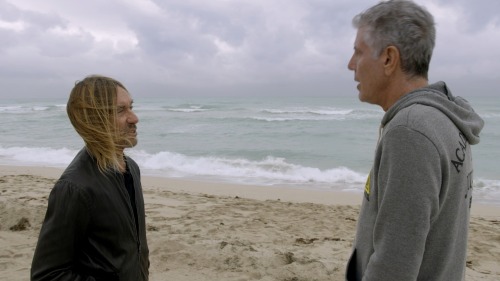
"I would also like to talk about Berlin. You both had experiences there, how long did you live there?
IP:
It feels like it was either three years or the better part of three
years. From the butt end of '76 through '77, '78 and '79 is a haze to
me. I knew more painters when I was there. I knew Rainer Fetting, Salomé
and I knew Martin Kippenberger pretty well. Kippy was an alcoholic,
agitating, troublemaker, you know? And he was like Kippy Kippenberger.
He looked like Ziggy Brzezinski. He looked like George C Scott in Dr Strangelove.
AB: Oh, wow.
IP:
And Kippy had to toot about everything. And he always had a bottle of
Sekt in his hand, 24 hours, alcoholic. But he had a beautiful loft, he
had a good 10,000 sq ft, I'd say, of Bauhaus loft space in Berlin for a
couple of hundred bucks. It was painters, hash dealers,
weird. The most beautiful thing about Berlin was there was still an old
ballroom on the Ku'damm. And once a week an organ player would come in
there and the old people would come and dance. And I would sit, you
would pay two marks to get in, and just watch and listen to music. And
there was a place, the Resi, an old place where you could dance. And
then on the stage there was a water show. It was a workers' social club.
And it had a huge dance floor ringed with booths, your good, spacious
German booths, not a cheap little SoHo French restaurant rip-off.
AB: Right.
IP: No, a good spacious booth. And each booth had a pole with a
number on it. And then you had a pad of paper and a pen. And what do
they call those vacuums?
AB: Oh, where you send those messages through a tube?
IP: Right. So you could write, "Booth number 89, you look pretty good..."
AB: A pneumatic tube.
IP:
"...Would you like to have a dance?" But without having to go through
the embarrassment. It's very German, you know? Have you been to Dresden?
AB: I haven't.
IP:
No, me either. I hear that seems to be having... it's full of
cost-conscious, hardline young Germans now. One thing that kept Berlin
afloat when I was there was the West German government gave a lot of
money to the educational institutions. The students were basically these
grumpy German draft dodgers. A lot of them were like, "I don't like
anything. Give me some more hash." I lived the same. They would
generally live in these Hinderhof flats with coal ovens. David Bowie
had a nice apartment in Schöneberg. I lived with him for a while. He
put in an expensive heater. And, later, after two winters, I put one in
too."
Only speed freaks (not a high-prestige set in 1969) and guys who
worked on their cars too much liked the STOOGES. “Problem” kids.
Tormented loners. Guys about whom there were terrible rumors. (“He went
mental and beat up his Mom.” “He shot somebody with a zip gun.”) That’s
the kind of guy who appreciated songs like the sado-masochistic “I Wanna
Be Your Dog,” the bleak “No Fun” (which pretty much summed up high
school for me), and the psychotic “TV Eye.”
Those were the days
when you held a new album in your hands and gaped at it for hours. You
read the liner notes again and again, peered hard and then harder at the
cover art, the photos on the back, trying to discern more — to glean
some kind of information about the strange and terrible people who made
these sounds that spoke, somehow, to the darkest regions of your teenage
heart.
And what to make of the STOOGES’ lead singer, “Iggy,”
whose apparent willingness to self-destruct in front of your eyes was
both exciting and genuinely frightening? To side with the STOOGES at
that time, to announce to your high school friends that you liked — no,
LOVED — THE STOOGES pretty much put one publicly on the road to The
Velvet Underground, The New York Dolls, early New York punk rock … and
heroin. Of
all the people I’ve met, I’ve never been more intimidated, more
anxious, more star-struck than when I met Iggy Pop. It was not in the
sort of place you’d expect to meet a rock and roll icon: a beach in the
Caribbean, oddly enough. I was attending a food and wine festival with
my family and looked out my window to see Iggy laying out on a blanket,
surrounded by nothing more toxic than mineral waters and fresh fruit.
For the next three days, I’d see him in the same place, soaking up the
rays and apparently rehabbing from a stage diving injury.
Though
my family’s blanket was but a few yards away, and my then-5 year-old
daughter would splash around in the water right next to him, it took me
three days to summon the nerve to say hello.
So, it was a dream
come true to actually hang out with my hero and (for better or worse)
early role model for the filming of this Sunday’s Miami episode of PARTS
UNKNOWN.
Now, some grumpy **** is going to point out, “Wait a minute, Iggy’s not from Miami! He wasn’t born here! What the ****?”
True
enough, but who in Miami WAS born in Miami? Believe me, we explore that
exact issue in this episode, with people who proudly WERE born here.
But
Iggy, like so many Miamians, came here to live after having lived a
previous life — or in Iggy’s case, many previous lives. Miami has always
been both refuge — and reward — for people from somewhere else, lured
by a long standing dream, the promise of some kind of peace of mind on a
beach.
Jeg faldt over den artikel i New Yorker, "Don't Eat Before Reading This", hvor Anthony Bourdain viste verden og sig selv, at han var lige så god til at skrive (om mad) som til at kokkerere, dette er det Harald Voetmannske højdepunkt (og jeg gik straks videre til at købe hans Kitchen Confidential, som artiklen knopskød til, som e-bog):
People who order their meat well-done perform a valuable service for
those of us in the business who are cost-conscious: they pay for the
privilege of eating our garbage. In many kitchens, there’s a
time-honored practice called “save for well-done.” When one of the cooks
finds a particularly unlovely piece of steak—tough, riddled with nerve
and connective tissue, off the hip end of the loin, and maybe a little
stinky from age—he’ll dangle it in the air and say, “Hey, Chef, whaddya
want me to do with this?” Now, the chef has three options. He
can tell the cook to throw the offending item into the trash, but that
means a total loss, and in the restaurant business every item of cut,
fabricated, or prepared food should earn at least three times the amount
it originally cost if the chef is to make his correct food-cost
percentage. Or he can decide to serve that steak to “the family”—that
is, the floor staff—though that, economically, is the same as throwing
it out. But no. What he’s going to do is repeat the mantra of
cost-conscious chefs everywhere: “Save for well-done.” The way he
figures it, the philistine who orders his food well-done is not likely
to notice the difference between food and flotsam.
Blogdahl er digter og WA-kritiker og Hvedekornsredaktør Lars Bukdahls blog – et føljeton-fortløbende, kunstnerisk og kritisk, polyfont collage-værk, der praktiserer og præsenterer, karakteriserer og bedømmer, diskuterer og debatterer, satiriserer og celebrerer primært litteratur (men også film, tv, teater, billedkunst, musik) gennem LB’s personlige sygekassebriller og pianistfingre.